The 2010 ADA Standards for Accessible Design (Section 407) set out how an elevator has to work for riders who use wheelchairs, are blind or have low vision, or are deaf or hard of hearing. The Texas Accessibility Standards (TAS) follow largely the same requirements. A compliant passenger elevator typically has:
Not sure whether your elevator meets these standards? We can check it and explain exactly what, if anything, needs to change.


Under the federal ADA, a private building generally needs an accessible route between floors unless it has fewer than three stories or less than 3,000 square feet per story. That exception does not cover shopping centers and malls, offices of health care providers, transit terminals or government buildings.
In Texas, construction and renovation projects with an estimated cost of $50,000 or more must be registered with the Texas Department of Licensing and Regulation (TDLR). A Registered Accessibility Specialist (RAS) then reviews the plans and inspects the finished work against the Texas Accessibility Standards. Local building codes can add their own requirements, so check before assuming a building is exempt.
Elevators and lifts in commercial and public buildings also need TDLR’s annual safety inspection. See Elevator Inspections & Compliance.
A full-size elevator isn’t always required or practical. Vertical platform lifts (wheelchair lifts) and inclined lifts provide access over a few steps or a short rise, and are built to the ASME A18.1 safety standard. ADA rules allow platform lifts in new construction only in specific situations, and more broadly in existing buildings where an elevator isn’t practical.
Limited-use/limited-application (LULA) elevators are smaller, lower-cost elevators allowed in some buildings that don’t need a full commercial elevator. They’re common in churches, schools and small offices. We’ll help you choose between a lift, a LULA and a standard elevator based on the rise, how often it’s used and what the code allows for your building.

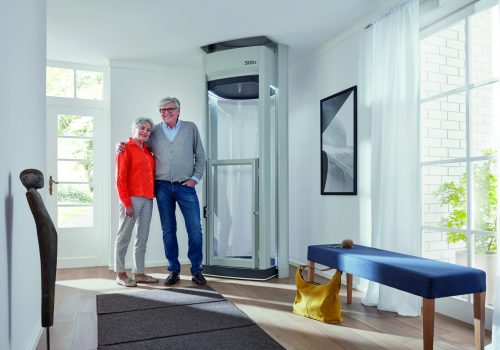
Private home elevators and lifts aren’t covered by the ADA, but many families choose accessible features anyway: a car with room for a wheelchair or walker, controls that are easy to reach, and smooth, level stops. We install and service home elevators and wheelchair lifts, including Stiltz home elevators, and can help you plan for a family member’s changing needs.
Not automatically. Businesses must remove barriers in existing buildings where it’s readily achievable, and new construction and alterations must meet current standards. When an elevator is modernized or the area around it is renovated, the parts being altered generally have to comply. We’ll tell you what applies to your project.
For projects with an estimated cost of $50,000 or more, a Registered Accessibility Specialist (RAS) reviews the plans and inspects the finished work under TDLR’s Architectural Barriers program. Separately, TDLR’s annual elevator inspection checks that the equipment is safe to operate.
It can be. A vertical platform lift can be part of an accessible route where the ADA allows it and the lift meets ASME A18.1. Lifts are common in existing buildings with a short rise, such as a raised entrance, a stage or a split-level floor.
No. Private homes aren’t covered by the ADA, but many homeowners choose accessible features so the elevator works for everyone in the family.
We handle accessibility for elevators and lifts from the first review to the final inspection:
Our approach is honest and straightforward. If a small fix will do, we’ll tell you. If a bigger upgrade is required, we’ll walk you through the options and help you plan for it.
Not sure where your elevator or lift stands? We review existing equipment, new construction plans and renovation projects, and we work with your architect, contractor and accessibility specialist so nothing is missed.
📍 Proudly serving clients across Texas.
Call Boyer Elevator at (979) 221-1401 or use this form to schedule an ADA review.
We handle accessibility for elevators and lifts from the first review to the final inspection:
Our approach is honest and straightforward. If a small fix will do, we’ll tell you. If a bigger upgrade is required, we’ll walk you through the options and help you plan for it.
Call Boyer Elevator at (979) 221-1401 or use the form below to schedule an ADA review of your elevator or lift.
PO Box 41749
Austin, Texas 78704
Phone: (979) 221-1401
Email: [email protected]
© 2026 Boyer Elevator Services, LLC. All Rights Reserved.

